Safety and Performance Layer
Signals v1 separates two concerns that are easy to conflate:
- Mechanism correctness: settlement meaning, pricing math, and accounting identities must remain consistent.
- Economic admissibility: market configuration must remain inside a solvency envelope that the maker-side capital stack can underwrite.
In v1, the safety envelope is enforced at market creation time. The protocol validates that a market's depth and prior are admissible given current maker-side capacity. The trading mechanism remains CLMSR; the safety layer constrains which markets can exist with which parameters.
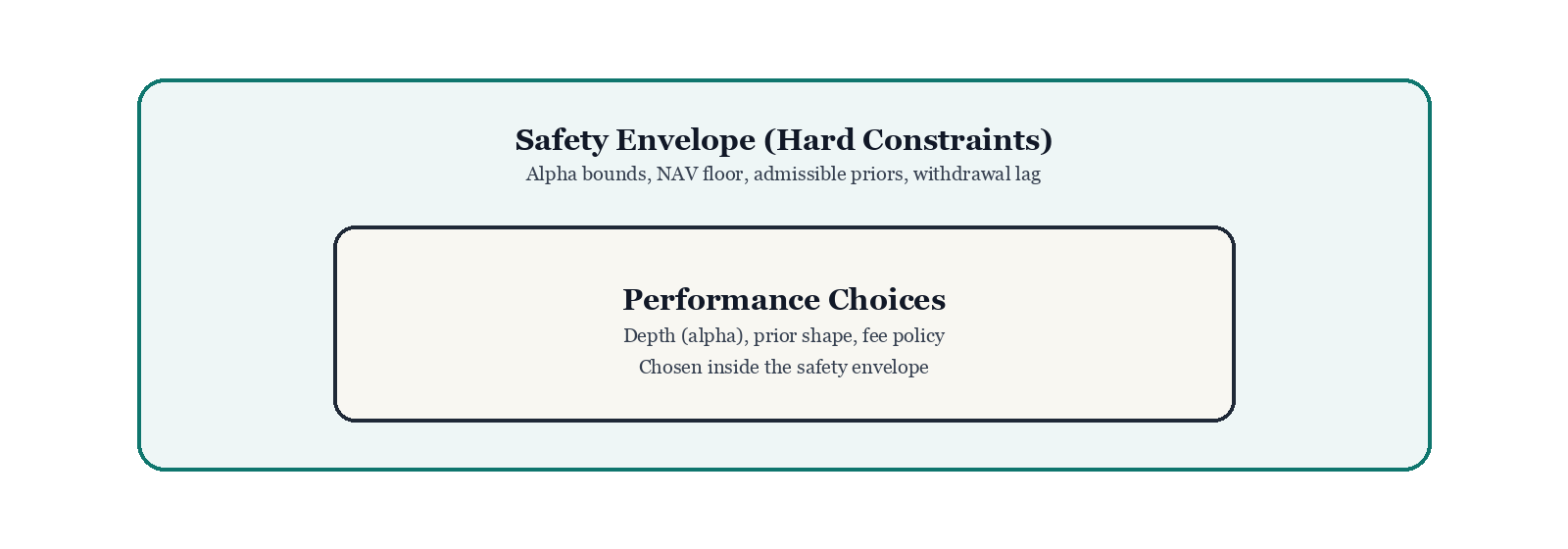
Figure: Performance choices live inside a non-negotiable safety envelope.
Safety envelope at market creation
Two checks define the core envelope:
- Depth admissibility: the market's depth parameter must be below an on-chain limit derived from maker-side capacity and outcome grid size.
- Prior admissibility: the market's prior factors must not be too concentrated relative to the effective backstop budget.
These checks are not an "alternative pricing mode." They are gates that decide which market configurations are allowed to exist.
The envelope exists to preserve a small set of mechanism-level invariants:
- claims are paid out from reserved escrow after settlement
- daily accounting remains internally consistent across settlement and fees
- market configuration does not imply a worst-case loss that exceeds the effective maker-side backstop budget
Depth admissibility
Each market has a depth parameter that scales CLMSR price impact. Higher compresses slippage for a given trade size; lower makes the curve more sensitive.
The safety layer derives a conservative upper bound on admissible depth from two public quantities:
- current maker-side capital (vault NAV)
- outcome grid size for the market
At a high level, the bound has the shape:
where is maker-side NAV and is a safety constant that caps uniform-prior worst-case loss as a fraction of NAV.
This bound has a direct CLMSR interpretation. For a market with ticks, CLMSR has a worst-case loss scale proportional to . Bounding that loss scale by a fraction of maker NAV yields the expression. The details of constant factors and rounding are implementation-specific, but the structural dependence is stable: admissible depth grows with maker NAV and shrinks as the grid has more ticks.
One way to state the idea is to treat as the "loss scale" of a market at a fixed resolution. Higher makes trading cheaper for the trader side (less slippage), but it also increases the maximum amount the maker can lose in the worst case. The admissibility gate treats that tradeoff as an explicit budget.
The base bound is tightened under peak drawdown:
with drawdown
where is the current maker share price and is the running peak.
In v1, this bound is enforced as a gate at market creation: a market cannot be created with above when enforcement is enabled. Depth is fixed per market at creation in the current release.
Two comparative statics are useful:
- Holding capital fixed, increasing increases and lowers . Finer resolution constrains admissible depth under the same capital stack.
- Holding fixed, drawdown increases and tightens . This ties new market admissibility to maker-side health.
Numeric sketch for
This sketch shows the scaling without relying on any particular deployment values.
Suppose:
- bins, so
- maker NAV is (in the protocol's internal fixed point)
Then:
If peak drawdown is and , the effective bound is:
The point is the scaling: tighter resolution (larger ) lowers admissible depth; drawdown lowers admissible depth; higher NAV raises admissible depth.
Prior admissibility
Signals markets can be initialized with a prior over ticks. The prior is represented as per-bin factors. A uniform prior produces no additional tail budget. A concentrated prior produces a positive tail budget that the backstop needs to cover.
The prior concentration is summarized by a tail budget term:
where is the sum of prior factors and is the minimum prior factor. Uniform priors satisfy and yield .
Admissibility is enforced as:
where is the effective backstop budget derived from the capital stack.
This gate prevents extremely concentrated priors from being listed without sufficient backstop capacity.
The ratio term is a concentration measure relative to the uniform baseline. Uniform priors have ratio 1 and yield . Concentrated priors have ratio greater than 1 and yield a positive . The log turns multiplicative concentration into an additive budget term.
Numeric sketch for
Suppose and the base factors are . Then:
The ratio is , so:
Holding the factor shape fixed, larger produces larger . This is consistent with the interpretation: a deeper curve makes a concentrated prior more expensive to underwrite.
Performance choices inside the envelope
Within the envelope, a market instance is defined by:
- the grid parameters (bounds and spacing)
- the depth
- the fee policy used for effective price
- the settlement timeline anchored at
In v1, depth and fee policy are set at market creation time. The curve semantics remain CLMSR. Fees remain an overlay applied on top of base cost. Execution differences across markets are attributable to different grid geometry, depth, or fee policy rather than hidden changes in the pricing rule.
The grid enters this layer indirectly through . Bounds and spacing determine how many ticks exist, and the number of ticks enters admissibility via . Resolution and admissible depth are therefore coupled through the safety model, even though the grid is a settlement object and is a pricing object.
Stress regimes
Stress enters the envelope through maker-side capital. If maker NAV draws down, the peak drawdown term increases and the admissible depth bound tightens. This restricts which new market configurations can be listed under the same capital stack.
The trading and settlement mechanism remains deterministic under stress:
- trading remains CLMSR state updates and fee overlays
- settlement remains candidate selection and explicit finalization
- claims remain time-gated payouts against a finalized tick
Stress changes admissible configuration and economics; it does not change payout meaning or settlement meaning.
In the current release, the envelope is applied at market creation time. This means the safety layer determines which market configurations can exist given the capital stack; it does not selectively block individual trades inside an already-listed market.
Clarifications
- A safety gate reverts market creation when an admissibility constraint is violated.
- Depth is fixed per market at creation in the current release.
- Fee overlays change effective price; base cost remains a CLMSR cost-function difference.
Related sections: